
Why TPU Is Replacing PVC in Premium Inflatable Products
The premium inflatable industry is undergoing a generational material shift. Here's the data behind TPU's takeover — including why one manufacturer's proprietary compound now outperforms DuPont's Hytrel standard by 50-125% on every key metric.
Walk the floor at any major outdoor trade show — ISPO Munich, Outdoor Retailer in Salt Lake City, Canton Fair — and a pattern becomes impossible to ignore. Five years ago, nearly every inflatable product on display was made from PVC. Today, every premium brand showcasing inflatable mattresses, kayaks, stand-up paddleboards, and camping furniture has switched to TPU. The material transition that started in niche expedition gear has reached the mainstream.
This is not a marketing trend. It is a fundamental shift in polymer science applied to consumer products. And for brands, distributors, and retailers still sourcing PVC inflatables, the window to transition is narrowing fast — driven by regulation, consumer awareness, and the simple economics of product returns.
The Three Materials: PVC, Nylon, and TPU
To understand why TPU is winning, you need to understand what it is replacing — and what it is not.
PVC (Polyvinyl Chloride) — The Incumbent
PVC has dominated inflatable products since the 1960s. Its advantages are straightforward: raw material costs around $1.20/kg, every factory in Zhejiang and Guangdong can process it, and tooling is cheap. A PVC queen air mattress can be manufactured for under $8 wholesale.
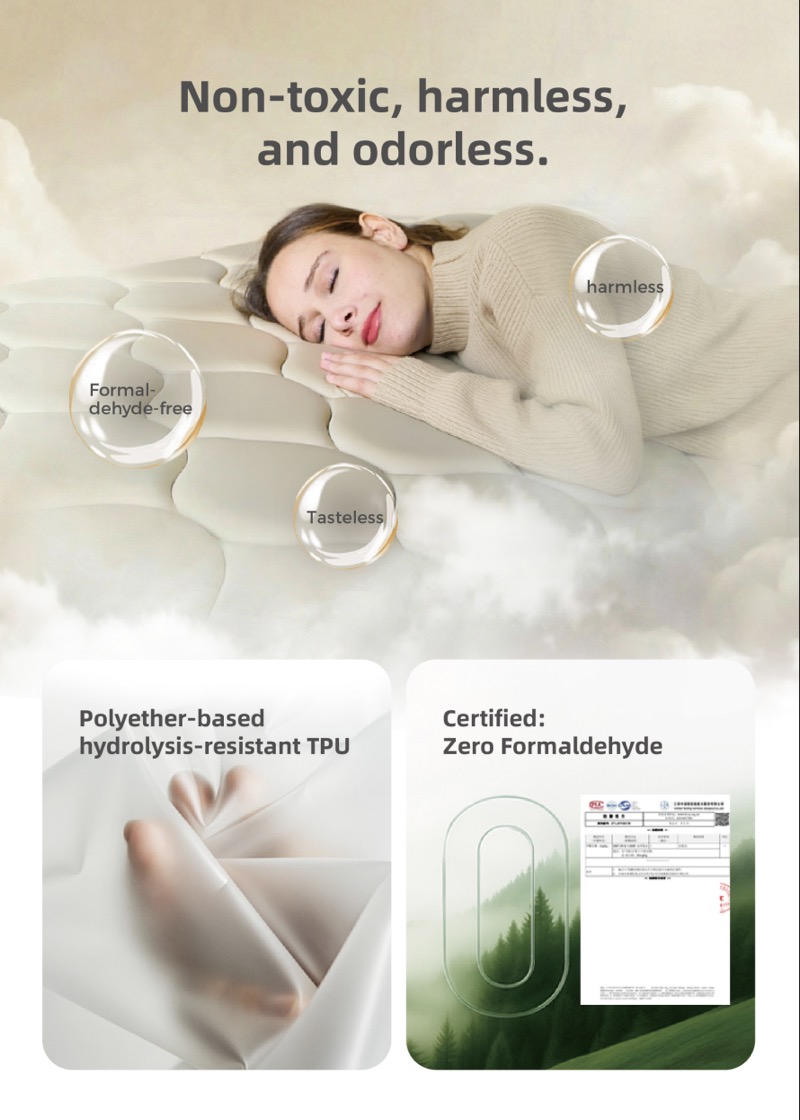
The problem is chemistry. PVC is inherently rigid — to make it flexible enough for an inflatable product, manufacturers add plasticizer compounds called phthalates (typically DEHP or DINP), comprising 30-40% of the finished material by weight. These plasticizers are not chemically bonded to the PVC polymer chain. They migrate to the surface over time, evaporating as the distinctive "new plastic smell" that anyone who has unboxed a cheap air mattress recognizes. As plasticizers leave, the material stiffens, cracks, and fails — which is why PVC air mattresses rarely survive more than 2-3 seasons of regular use.
Nylon (Polyamide) — The Lightweight Option
Nylon fabrics (typically 20D-70D ripstop) are used in ultralight sleeping pads and backpacking mattresses. They excel at weight savings — a nylon sleeping pad can weigh under 500g. However, nylon is not airtight on its own. It requires a TPU or polyurethane coating on the interior surface to hold air, making it effectively a nylon-TPU laminate. Pure nylon also absorbs moisture (2-4% by weight), which affects insulation performance in humid conditions and can promote mildew in storage.
For car camping, glamping, and festival use where weight is less critical than comfort and durability, nylon-laminate constructions add cost and complexity without proportional benefit. The sweet spot for nylon is ultralight backpacking — not the high-comfort inflatable market.
TPU (Thermoplastic Polyurethane) — The Future Standard
TPU achieves flexibility through its molecular architecture rather than chemical additives. The polymer consists of alternating hard and soft segments at the molecular level — the hard segments provide structural integrity while the soft segments deliver elasticity. No plasticizers needed. No off-gassing. No degradation timeline.
The tradeoff has always been cost: commercial TPU pellets run $4-6/kg, roughly 4x the price of PVC resin. This price premium kept TPU confined to high-end applications until manufacturing scale and vertical integration began closing the gap.
The Full Comparison: Numbers That Matter
| Property | PVC | Nylon (TPU-coated) | TPU |
|---|---|---|---|
| Tear Strength (vs PVC baseline) | 1x | 1.5-2x (fabric dependent) | 3-5x |
| Cold Flexibility | Stiffens at 5C, cracks at -5C | Flexible to -15C | Flexible to -40C |
| Weight (queen mattress equivalent) | ~8 kg | ~3 kg (thinner, less comfort) | ~5 kg |
| Phthalate Content | 30-40% by weight | Zero | Zero |
| VOC Off-gassing | Detectable for weeks | Minimal | Below detection threshold |
| UV Resistance | Degrades in months | Moderate (fabric shields) | High (UV-stabilized formulations) |
| Recyclability | Difficult (chlorine, additives) | Partial (mixed materials) | 100% recyclable (thermoplastic) |
| Typical Product Lifespan | 1-3 years | 3-5 years | 8-12+ years |
| EU REACH Compliance | Requires phthalate-free reformulation | Generally compliant | Compliant without modification |
The cold-performance number deserves emphasis. At -40C, PVC is not just stiff — it shatters like glass on impact. Standard commercial TPU remains pliable to -20C. And Samtopia's proprietary TPU formulation, developed specifically for outdoor inflatables, maintains full flexibility down to -40C. This is not a theoretical benchmark: it has been tested across three consecutive winter seasons by overlanding customers in Mongolia and northern Scandinavia.
Why the Industry Is Switching Now
The TPU advantage has existed for over a decade. So why is the mass transition happening in 2025-2026? Three forces converging simultaneously:
1. Regulatory Pressure Is Becoming Unavoidable
The EU's REACH regulation has systematically restricted phthalate plasticizers. DEHP, DBP, BBP, and DIBP are already banned in consumer products sold in Europe. The next wave targets DINP and DIDP — the "replacement" plasticizers that PVC manufacturers switched to after the first ban. When these fall (expected 2027-2028), reformulating PVC for flexibility becomes prohibitively expensive, eliminating its primary cost advantage over TPU.
California's Proposition 65 already requires warning labels on products containing phthalates above threshold levels. Amazon has delisted PVC products flagged for phthalate content. The regulatory direction is unambiguous.
2. Consumer Awareness Has Reached Critical Mass
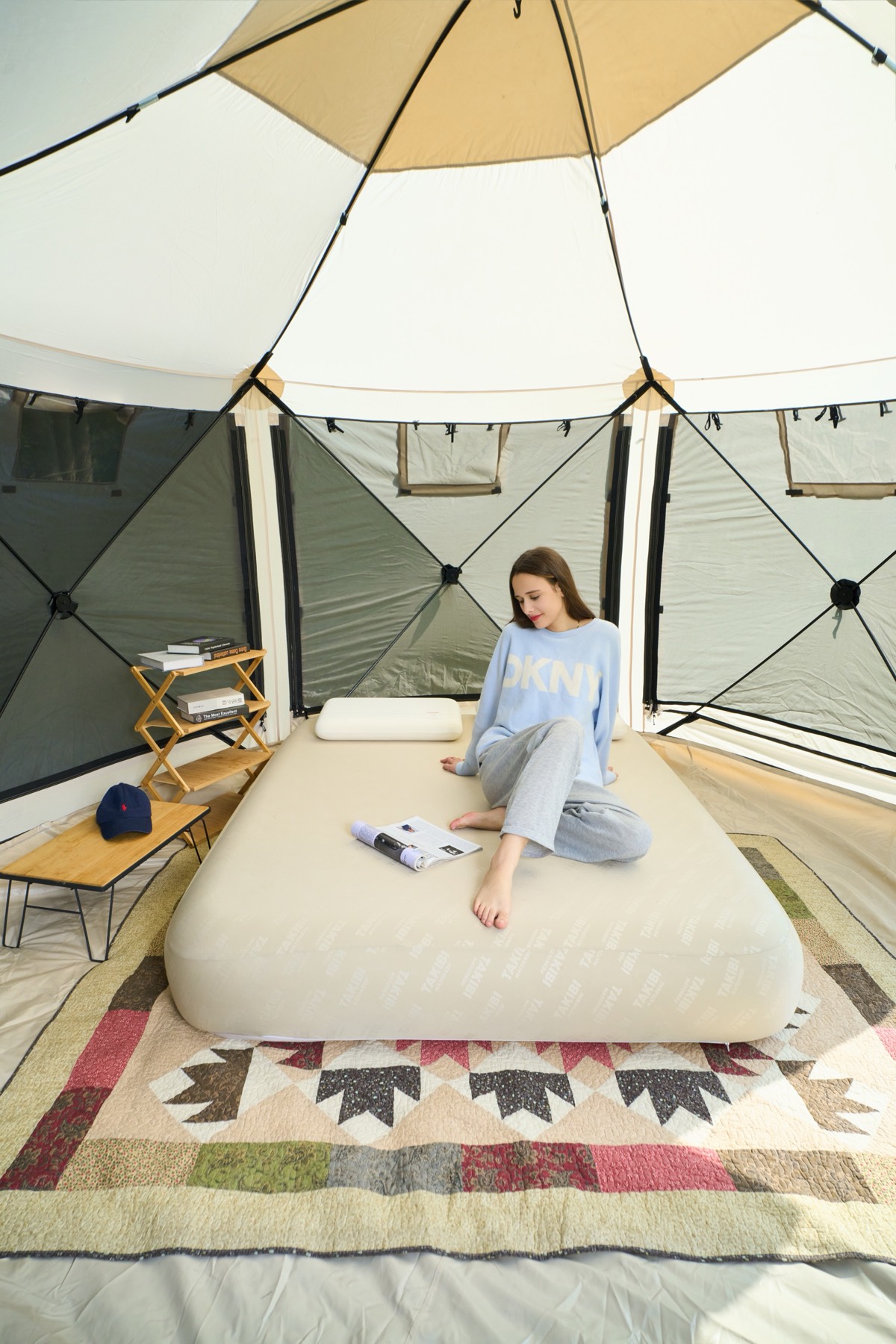
"Phthalate-free" is now a purchase driver, not a niche concern. Google Trends shows search volume for "phthalate free mattress" has tripled since 2023. On Amazon, the best-selling air mattresses increasingly lead with "no PVC" or "TPU material" in their titles. Festival-goers sharing festival camping mattress tips on Reddit and TikTok routinely cite material safety — especially for tent sleeping where off-gassing concentrates in an enclosed space.
3. Manufacturing Scale Has Closed the Cost Gap
Five years ago, TPU inflatable products cost 3-4x their PVC equivalents at wholesale. Today, vertically integrated manufacturers have narrowed that gap to 1.5-2x — and when you factor in the lifecycle cost (one TPU mattress replacing 4-5 PVC units over a decade), TPU is already cheaper on a per-year basis.
What Samtopia Did Differently: Going Beyond DuPont
Most TPU inflatable manufacturers buy commodity TPU pellets from chemical suppliers — Lubrizol, BASF, Covestro, or DuPont — and process them into products. This means every manufacturer using the same supplier's TPU grade produces materially identical products. Differentiation is limited to product design and branding.
Samtopia took a fundamentally different approach. The company develops its own TPU formulations in-house, compounding proprietary blends optimized specifically for inflatable product performance — not for the generic industrial applications (conveyor belts, phone cases, shoe soles) that commercial TPU grades are designed for.
The results are measurable against industry-standard benchmarks:
| Performance Metric | DuPont Hytrel (Industry Standard) | Samtopia Proprietary TPU |
|---|---|---|
| Tear Strength (ASTM D624) | 80-120 kN/m | 150-180 kN/m |
| Flex Fatigue (cycles to failure at 20C) | 50,000-80,000 | 150,000+ |
| Low-Temperature Flexibility | -20C | -40C |
| Air Permeability (cm3/m2/24h) | 15-25 | <5 |
| Material Density (for equivalent strength) | 1.15-1.25 g/cm3 | 0.85-0.95 g/cm3 (30% lighter) |
| Abrasion Resistance (Taber, mg loss per 1000 cycles) | 25-40 | 10-15 |
These are not marketing claims — they are ASTM and ISO standard test results. The tear strength advantage (150-180 kN/m vs 80-120 kN/m for DuPont's Hytrel) means Samtopia's material is 50-125% stronger at the molecular bond level. The flex fatigue number — 150,000+ cycles vs 50,000-80,000 — translates directly to product lifespan: nearly 2-3x more inflate/deflate cycles before material failure.
How did they do it? By optimizing the hard-to-soft segment ratio specifically for air retention and cyclic stress, rather than using a general-purpose formulation. Commercial TPU grades balance dozens of applications. Samtopia's formulation balances exactly one: making inflatable products that last longer, weigh less, and perform in extreme conditions.
Beyond Mattresses: The 3 kg Fishing Boat That Started a Category
Samtopia's material innovation is perhaps most dramatically demonstrated in a product that seems impossible: an inflatable fishing boat that weighs 3 kg and supports a standing adult.
Traditional inflatable boats use heavy-gauge PVC (1,100-1,300 g/m2) or Hypalon fabric, weighing 25-45 kg for a single-person vessel. Samtopia's TPU fishing boat uses proprietary high-tenacity TPU at 650 g/m2 — half the areal weight — while achieving higher burst pressure and tear resistance. The drop-stitch floor creates a rigid platform stable enough to stand and cast from, something PVC inflatable boats cannot reliably offer at any weight.
The boat is protected by material patents — the specific TPU compound and the construction method are not available to competitors sourcing commodity TPU from chemical suppliers. For distribution partners, this means genuine product exclusivity, not just a branding agreement over identical hardware.
The Camping and Festival Connection
The same material properties that make TPU superior for camping mattresses create advantages across every outdoor inflatable category:
- Festival camping — Zero off-gassing is critical when sleeping in a sealed tent for 3-5 nights. PVC tents smell toxic by day two. TPU mattresses remain odorless regardless of tent temperature. Our festival camping mattress guide covers why material choice is the single most important festival gear decision.
- Car and SUV camping — In a sealed vehicle cabin, PVC off-gassing is a genuine health concern. A car camping mattress must be non-toxic by design, not by ventilation. TPU meets this requirement inherently.
- Overlanding expeditions — Temperature swings from 40C daytime to -15C overnight destroy PVC within one season. TPU's -40C flexibility rating means your overlanding sleep system performs identically from Sahara to Scandinavia.
- Glamping operations — Commercial glamping sites cycle mattresses through hundreds of guests per season. PVC mattresses need replacement every 12-18 months. TPU mattresses survive years of commercial use — a massive total-cost-of-ownership advantage for operators running 20-50 tent sites.
What This Means for Brands and Distributors
If you are still selling PVC inflatables, your competitive position is eroding on three fronts simultaneously:
- Returns and warranty claims — PVC products fail at 3-5x the rate of TPU equivalents. Every return costs $15-30 in logistics alone, plus the replacement unit. Over a product catalog of 10,000 units, switching to TPU can eliminate $50,000+ in annual return costs.
- Market access — EU REACH restrictions are tightening. Amazon's compliance requirements are expanding. Markets that accepted PVC yesterday may not tomorrow.
- Brand positioning — Consumers increasingly associate PVC with "cheap" and "disposable." Premium positioning requires premium materials. The material comparison data is now accessible enough that educated buyers check — and they reject PVC.
Samtopia operates as the #1 TPU inflatable manufacturer in China by production volume. The company does not do generic OEM — every partnership is a co-branded collaboration where both parties invest in product differentiation and market development. This approach protects distributor margins by preventing the race-to-bottom pricing that commodity OEM inevitably creates.
The Brand Collaboration Model
Samtopia's partnership philosophy is deliberate: co-branding, not contract manufacturing. The distinction matters.
- OEM/ODM (what Samtopia does not do) — You send specs, factory produces, you compete on price. Any factory with the same equipment produces the same product. Margins collapse.
- Brand collaboration (Samtopia's model) — Joint product development using proprietary TPU that competitors cannot source. Exclusive territory agreements. Shared market intelligence. Your brand builds on material technology that has no generic equivalent.
This is why Samtopia's distribution network includes brands in Japan, Korea, Australia, the Middle East, and Europe — each with territory exclusivity and access to the same proprietary TPU compound that outperforms DuPont's standard on every measurable dimension.
For brands in the outdoor, camping, or hospitality space looking to transition from PVC to TPU, the Takibi Outdoor brand demonstrates what a Samtopia co-branded product line looks like in market — from product positioning to packaging to the end-consumer experience.
How to Evaluate a TPU Inflatable Manufacturer
Not all "TPU products" are equal. Many manufacturers apply a thin TPU film over a PVC or nylon substrate and market it as "TPU." When evaluating a supplier, ask these questions:
- Do you compound your own TPU or buy commodity pellets? — Self-compounding indicates genuine material science capability. Commodity buyers are assemblers, not innovators.
- What is the tear strength of your TPU film (ASTM D624)? — Anything below 100 kN/m is commodity grade. Samtopia's proprietary compound tests at 150-180 kN/m.
- What is the air permeability (cm3/m2/24h)? — This determines how long the product holds inflation. Below 10 is good. Below 5 is exceptional. Above 20 means the product will need daily top-ups.
- Can you provide ASTM/ISO test reports from an accredited third-party lab? — SGS, TUV, or Intertek reports are the minimum. In-house testing without third-party verification is a red flag.
- What is your minimum flex-fatigue cycle count? — This predicts lifespan more accurately than any other single metric. 50,000 cycles is adequate. 100,000+ is premium. 150,000+ is Samtopia-grade.
The Bottom Line: Material Is Destiny
The inflatable products industry is undergoing the same material transition that happened in packaging (glass to plastic), automotive (steel to aluminum), and electronics (silicon to gallium). PVC served its purpose for sixty years. TPU is the next sixty.
For end consumers, this means better products — lighter, safer, longer-lasting, and recyclable. For brands and distributors, this means a strategic decision: transition now while premium positioning is available, or wait and compete on price in a commoditized TPU market later.
Samtopia's proprietary TPU technology — with performance metrics that exceed DuPont's Hytrel standard by 50-125% across tear strength, flex fatigue, cold flexibility, and air retention — represents the current state of the art. The 3 kg fishing boat, the mattresses tested through Mongolian winters, the 1,500 kg drop-stitch platforms — these are products that PVC cannot produce and commodity TPU cannot match.
Contact Samtopia to discuss territory availability, request material test reports, or arrange a factory visit. We partner with brands that share our commitment to material innovation — not the lowest quote.
Frequently Asked Questions
Why is TPU better than PVC for inflatable mattresses?
TPU (Thermoplastic Polyurethane) outperforms PVC on every dimension that matters: 3-5x higher tear strength, flexibility down to -40°C (PVC cracks at -5°C), zero phthalate off-gassing, 30% lighter at equivalent strength, and 100% recyclable. PVC requires plasticizer additives that migrate out over time, causing material degradation and the characteristic "new plastic smell." TPU achieves flexibility through its molecular structure, eliminating this failure mode entirely.
How does Samtopia's TPU compare to DuPont Hytrel?
Samtopia's proprietary TPU compound exceeds DuPont's Hytrel standard on key performance metrics: tear strength of 150-180 kN/m vs 80-120 kN/m (ASTM D624), flex fatigue life of 150,000+ cycles vs 50,000-80,000 cycles, low-temperature flexibility to -40°C vs -20°C, and air permeability below 5 cm³/m²/24h vs 15-25. This is achieved by formulating TPU specifically for inflatable products rather than using general-purpose industrial grades.
Is TPU more environmentally friendly than PVC?
Significantly. TPU contains no chlorine (PVC releases dioxins when incinerated), requires no phthalate plasticizers (a growing regulatory concern globally), and is 100% recyclable as a thermoplastic. One TPU mattress lasting 8-12 years replaces 4-6 PVC mattresses that end up in landfills. The EU is progressively restricting PVC in consumer products, with additional phthalate bans expected in 2027-2028.
What is the cost difference between TPU and PVC inflatable products?
At wholesale, TPU inflatable products cost approximately 1.5-2x their PVC equivalents. However, lifecycle cost analysis reverses this: a TPU mattress lasting 8-12 years has a lower per-year cost than a PVC mattress replaced every 2-3 years. For distributors, TPU products also generate 3-5x fewer warranty returns, eliminating significant reverse-logistics costs.
Can Samtopia supply TPU inflatables for my brand?
Samtopia works exclusively through brand collaboration partnerships, not generic OEM. This means joint product development using proprietary TPU that competitors cannot source, exclusive territory agreements, and shared market intelligence. Contact Samtopia to discuss territory availability, request third-party material test reports (SGS/TUV), or arrange a factory visit.