
Air Mattress Deflating Overnight? 4 Real Causes & Proven Fixes (Not Always a Leak)
Your air mattress deflating overnight might not be a leak. Understand the 4 real causes — temperature, valves, material fatigue, and over-inflation — and how to stop deflation for good.
You inflated your air mattress before bed, and by 3 AM you're lying on a half-flat surface with your hip touching the ground. Before you blame a leak, understand this: most overnight deflation is not caused by a hole. Here are the four real causes — and how to solve each one.
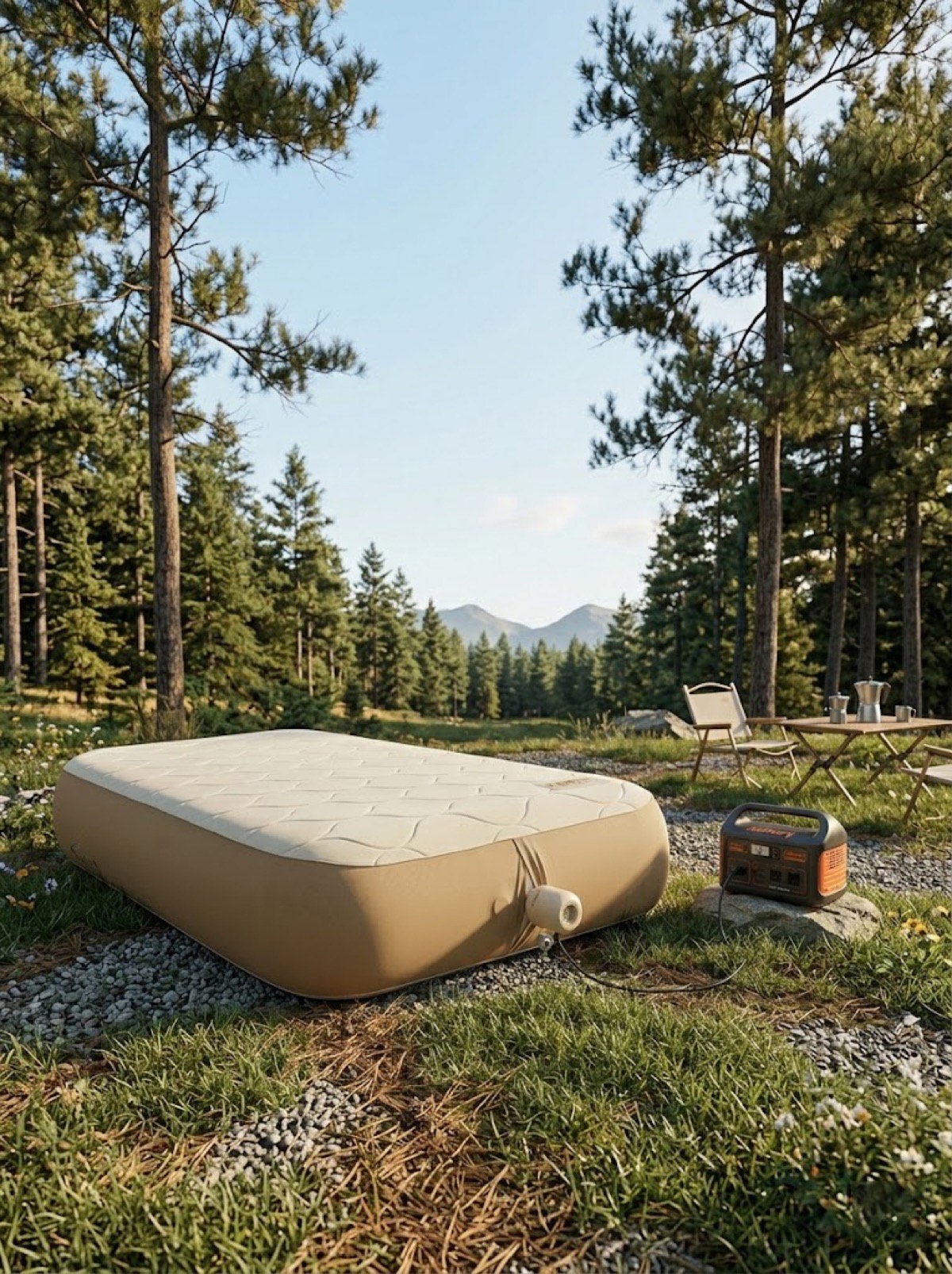
Cause 1: Temperature Drop (The Most Common Reason)
Air is a gas, and gases contract when they cool. This is Charles's Law — for every 10°C drop in temperature, air volume decreases by approximately 3.4%. If you inflate your mattress at 25°C and the temperature drops to 5°C overnight (common in autumn camping), you'll experience roughly a 7% volume reduction.
That 7% doesn't sound like much, but on a king-size mattress with 200+ liters of air, it translates to a noticeable loss of firmness — especially around your shoulders and hips where body weight concentrates pressure.
Solution
- Slightly over-inflate before bed (add 2-3 extra pumps beyond your comfort level)
- Place an insulating barrier between mattress and cold ground (a foam pad or blanket underneath)
- Choose a mattress with higher volume — larger air chambers are less affected percentage-wise
Cause 2: Valve Issues
The valve is the weakest point of any air mattress. Common valve problems include:
- Debris in the seal — sand, dirt, or hair preventing complete closure
- Cross-threaded cap — the valve cap is not seated correctly
- Worn gasket — the rubber/silicone seal inside the valve has degraded
- Stretched valve body — over-inflation has expanded the valve housing
Solution
Clean the valve thoroughly with a damp cloth and inspect the gasket. Close the valve and listen — you should hear nothing. If you hear a faint hiss, the valve needs servicing or replacement. Quality mattresses (including Samtopia) use dual-seal valve systems with replaceable gaskets.
Cause 3: Material Fatigue (PVC Aging)
PVC air mattresses develop micro-porosity over time. Plasticizers in PVC evaporate gradually (this is the "new plastic smell" fading), making the material stiffer and creating microscopic pathways for air to escape. After 12-18 months of regular use, a PVC mattress may lose air 20-30% faster than when new — even without any visible puncture.
Solution
There is no fix for material-level PVC degradation. The mattress needs replacement. If this pattern repeats, switch to TPU material. Samtopia's proprietary self-developed TPU does not contain plasticizers (it achieves flexibility through molecular structure, not additives), so there is no degradation pathway. TPU mattresses maintain their air-tightness for many years.
Cause 4: Over-Inflation Stress
Counter-intuitively, inflating a mattress too firmly can cause faster deflation. Excessive internal pressure stresses seam welds and pushes air through microscopic imperfections that would remain sealed at normal pressure. This is especially true for PVC mattresses with heat-welded seams.
Solution
Inflate until the mattress is firm but still yields slightly to hand pressure. You should be able to press down 1-2 cm with your palm. If the surface feels drum-tight, release a small amount of air. Drop-stitch construction (used in Samtopia mattresses) distributes pressure uniformly across 20,000+ internal fibers per square meter, eliminating pressure hotspots at seams.
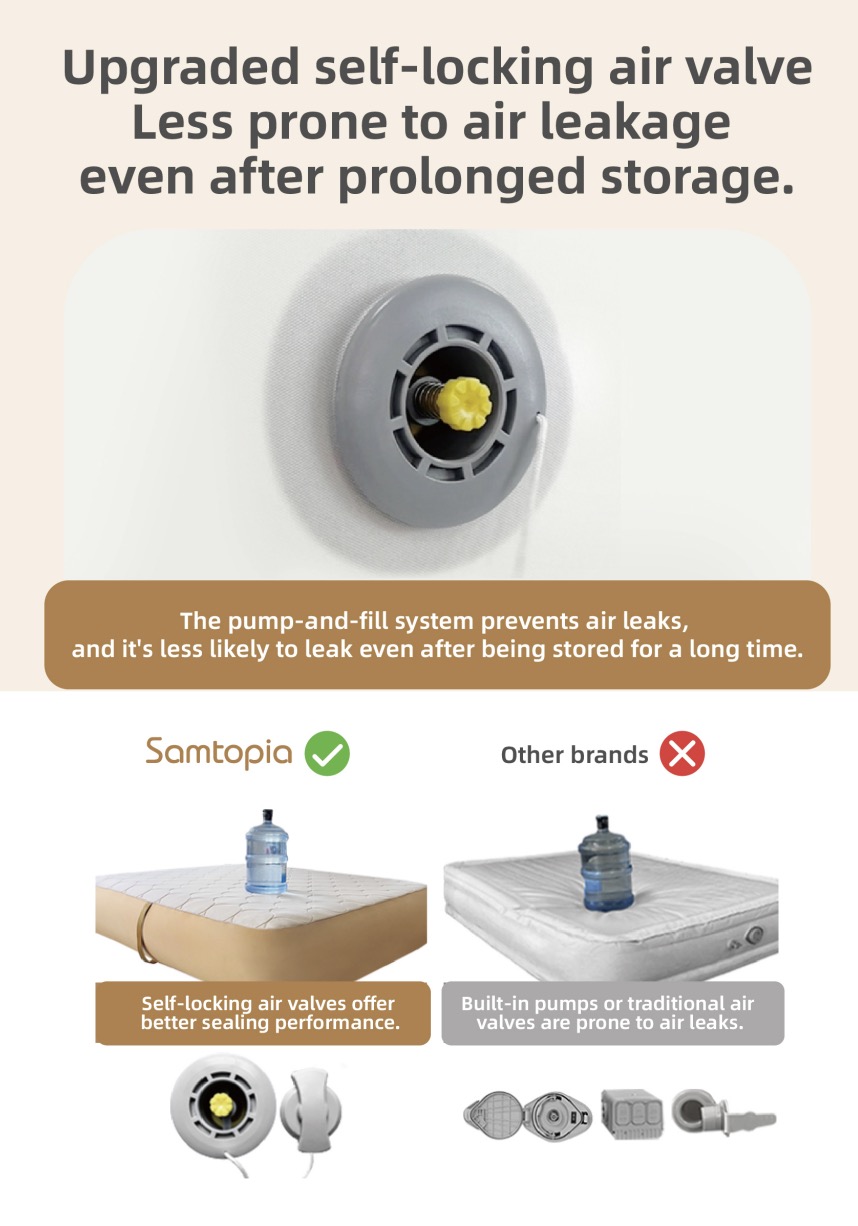
The Material Factor: Why TPU Solves Most Deflation Issues
| Factor | PVC Mattress | Samtopia Self-Developed TPU |
|---|---|---|
| Temperature tolerance | Stiffens below 5°C, cracks below -5°C | Flexible to -30°C, no air-tightness loss |
| Material aging | Plasticizers evaporate → micro-porosity in 12-18 months | No plasticizers → zero degradation for many years |
| Seam integrity | Heat-welded → stress concentration points | RF-welded TPU → molecular bond stronger than base material |
| Puncture from pets | Cat/dog claws penetrate easily | Pet-claw resistant (tested — no puncture from normal use) |
| Weight | Heavy (PVC is dense) | 30% lighter than equivalent PVC or standard TPU |
| Inflation hold time | 1-2 days before noticeable softening | 5-7 days with no top-up needed |
Quick Diagnostic Checklist
- Is the temperature dropping more than 10°C at night? → Thermal contraction (normal)
- Is the deflation worse near the valve? → Valve issue (clean or replace gasket)
- Is the mattress more than 18 months old (PVC)? → Material fatigue (time to upgrade)
- Did you inflate until drum-tight? → Over-inflation stress (let out some air)
- Does the deflation happen even in warm, stable conditions? → Likely a puncture (see our repair guide)
Frequently Asked Questions
Why does my air mattress keep deflating overnight?
The most common reason an air mattress deflates overnight is temperature drop — not a leak. When nighttime temperatures fall by 10-15°C, air inside the mattress contracts by about 5%, making it feel noticeably softer by morning. This is Charles's Law in action. Other causes include worn valve seals that allow slow air escape, material fatigue in PVC mattresses creating micro-perforations along seams, and over-inflation that stresses seals. If your mattress loses more than 20% firmness overnight, investigate valves and seams.
How do I stop my air mattress from deflating?
Five proven fixes: (1) Slightly over-inflate before bed to compensate for thermal contraction overnight. (2) Check the valve — push it in firmly, twist to lock, and inspect the rubber seal for cracks. (3) Place an insulating layer (blanket or foam pad) between the mattress and cold ground to reduce temperature-driven deflation. (4) Avoid placing the mattress near windows, tent walls, or drafty areas. (5) Upgrade to a TPU mattress — TPU maintains air-tightness down to -30°C, while PVC becomes stiff and develops micro-cracks below 5°C, which is why PVC air beds deflate faster in cold weather.
Is it normal for an air mattress to lose some air overnight?
Yes, losing 5-10% firmness overnight is completely normal and is not a defect. Air contracts as temperature drops — a 15°C drop can reduce air volume by approximately 5%. This is basic gas physics (Charles's Law), not a leak. If you lose more than 20% firmness overnight, investigate other causes like valve issues or material degradation.
Why does my air bed deflate overnight even without a hole?
An air bed can deflate overnight without any visible hole due to three mechanisms: (1) Thermal contraction — cooler nighttime air takes up less volume, reducing internal pressure. (2) Micro-perforations — PVC material develops invisible pinholes along heat-welded seams after repeated inflation cycles, especially in cold or humid conditions. (3) Valve creep — the check valve gradually loosens over time, allowing slow air escape you cannot hear. TPU air beds are significantly less prone to these issues because the material has 5x the flex-fatigue life of PVC and the molecular structure resists micro-cracking.
How long should an air mattress stay inflated?
A quality air mattress should hold its shape for 2-3 days with no noticeable loss. Premium TPU mattresses like Samtopia can maintain full inflation for 5-7 days between top-ups. If your mattress deflates significantly within 24 hours, there is likely a valve issue or a puncture that needs repair.
Does the weight of sleepers cause air mattresses to deflate faster?
Weight does not cause air to escape — it redistributes it. Two people on a mattress rated for their combined weight will not deflate it faster. However, exceeding the weight limit creates excessive pressure on seams and valves, accelerating wear. Samtopia TPU30 King supports 1,500kg (three adults), providing ample margin for typical two-person use.
What type of air mattress does not deflate?
No air mattress is 100% immune to deflation from temperature changes, but TPU (Thermoplastic Polyurethane) air mattresses hold air significantly better than PVC models. TPU has superior molecular bonding that resists micro-cracking, maintains flexibility from -30°C to 70°C, and does not degrade from UV exposure or humidity. Samtopia TPU mattresses are tested to hold pressure for 7+ days without topping up, compared to 1-2 days for typical PVC air beds.